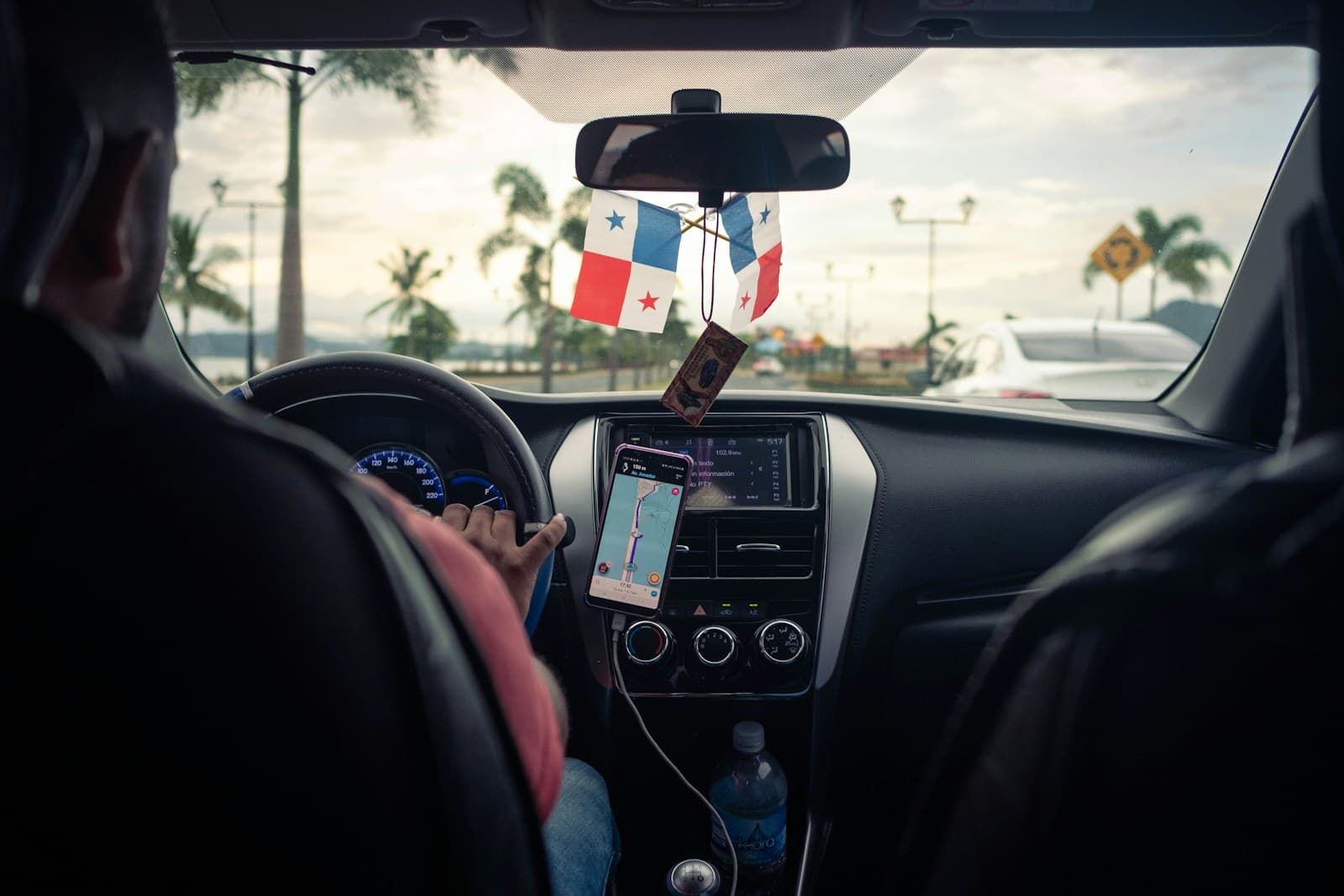
Your rideshare income depends on driving, but Florida's Business Purposes Only license restricts your routes to specifically documented destinations. Most drivers don't realize that rideshare pickups require employer documentation proving each route is work-essential, not customer-driven.
Why Florida's BPO License Doesn't Automatically Cover Rideshare Routes
Florida's Business Purposes Only (BPO) license allows driving to and from work, educational institutions, church, medical appointments, and locations required to maintain your livelihood. Rideshare drivers assume passenger requests qualify as work routes because they generate income. Florida DMV interprets BPO restrictions differently: your approved routes must be documented in advance with specific addresses, and customer-initiated destinations count as personal travel unless your rideshare company submits employer verification listing each pickup zone as a required work location.
The practical problem: Uber and Lyft do not provide route-specific employer letters. Their standard employment verification confirms you drive for the platform but does not list specific geographic zones as mandatory work destinations. Without that documentation, DMV treats every passenger pickup outside your explicitly approved address list as unlicensed driving, even when the trip generated W-2 income.
Most BPO denials for rideshare drivers trace to this documentation gap. The application requires employer letterhead stating the specific addresses you must drive to for work. A rideshare platform cannot predict where passengers will request pickups, so they cannot provide the advance route documentation Florida's BPO process demands. Drivers who submit standard employment letters without address specificity face application denial or post-approval revocation when law enforcement discovers route deviation during a traffic stop.
What Florida Considers an Approved Work Route for BPO Purposes
Florida Statute 322.271 grants BPO driving privileges for "business purposes only," defined as driving necessary to maintain your employment. The statute does not enumerate rideshare as a category. Florida DMV applies a fixed-address interpretation: your employer must certify that driving to specific named locations is a condition of continued employment.
Approved work routes for W-2 employees are straightforward. Your employer submits a letter listing your work address, and DMV approves a route from your residence to that address during your documented shift hours. Rideshare drivers operate as independent contractors with no fixed work location. The passenger initiates the destination, not the employer. DMV does not recognize customer choice as employer necessity.
Delivery drivers face the same structural problem, but food delivery and package delivery companies sometimes provide zone-based route letters covering a geographic service area rather than individual addresses. Rideshare platforms do not issue equivalent documentation. Without it, BPO approval is limited to the address of the rideshare company's local office (if one exists) or your vehicle inspection location, neither of which generates income. Drivers approved under this narrow interpretation cannot legally accept passenger requests without violating their BPO restrictions.
Compare car insurance rates in your state
Get quotes from licensed carriers — no obligation, no spam, results in minutes.
Get Your Free Quote✓ No Obligation Required✓ Licensed Carriers Only✓ Available Nationwide✓ Free to Compare
How Law Enforcement Discovers BPO Violations During Rideshare Trips
Florida law enforcement checks BPO compliance during every traffic stop. Officers verify your destination matches an address on your approved route list. If you are carrying a rideshare passenger to a location not listed on your BPO court order, the stop triggers an unlicensed driving charge regardless of whether the trip was generating income.
Most rideshare BPO violations occur during evening and weekend enforcement. Your BPO order specifies approved driving hours tied to your documented work schedule. Rideshare income depends on high-demand periods—Friday and Saturday nights, airport runs, event surges—that fall outside traditional business hours. If your employer letter documents a Monday-Friday 9 a.m. to 5 p.m. office job, driving a passenger at 11 p.m. Saturday violates both the time and destination restrictions, even if rideshare driving is your second job.
Officers also cross-reference your passenger's stated destination against your approved address list. A rideshare passenger traveling to a bar, airport, or residential address creates an immediate compliance problem unless that exact address appears on your BPO documentation. The violation is processed as driving while license suspended, which in Florida carries up to 60 days in jail for a first offense and up to one year for a second offense within five years. Your BPO license is revoked immediately, and the underlying suspension period often extends.
Why Most Rideshare Drivers Should Pursue Full Reinstatement Instead
BPO license restrictions make rideshare income legally unattainable for most Florida drivers. Full reinstatement costs more upfront but removes route and hour restrictions entirely. For drivers whose primary income depends on flexible passenger requests, paying reinstatement fees and meeting SR-22 filing requirements is faster and safer than navigating BPO compliance.
Florida charges a $45 BPO application fee and requires proof of enrollment in DUI school (if suspension was alcohol-related) before DMV processes your petition. Approval takes 10 to 15 business days. Full reinstatement costs vary by suspension cause: $150 for a first DUI suspension, $250 for subsequent violations, and $500 for uninsured-driver suspensions. SR-22 filing is required for both BPO and full reinstatement in alcohol-related and uninsured-driving cases, so insurance costs do not differ between the two paths.
The reinstatement timeline for insurance lapse suspensions is immediate once you file SR-22 proof with Florida DMV. You pay the reinstatement fee, submit SR-22, and receive full privileges within 3 to 5 business days. BPO applications require a hardship hearing in some counties, employer documentation, and judicial approval, often taking 4 to 6 weeks. For rideshare drivers, the restricted license adds compliance risk without reducing cost or timeline. If your suspension was triggered by insurance lapse rather than DUI, full reinstatement is the correct path.
If You Pursue BPO Anyway: Documentation Requirements That Actually Work
If your suspension involves a mandatory waiting period before reinstatement eligibility, BPO may be your only legal option during that window. Rideshare drivers who must use BPO need documentation that anticipates DMV's fixed-address requirement. The solution: document a non-rideshare job with fixed routes, and limit rideshare activity to offline hours.
Your employer letter must list specific addresses on company letterhead. Include your primary job's work address, any required client sites, medical appointments if you have a documented condition, your child's school or daycare, and your DUI program location if enrollment is a reinstatement condition. Do not mention rideshare income in your BPO application. DMV evaluates whether the listed addresses are necessary to maintain employment, not whether they represent all your income sources.
Once your BPO is approved, you can accept rideshare requests only if the pickup and destination both fall on your approved route during your approved hours. For most drivers, this means airport trips are prohibited, weekend shifts are prohibited, and any passenger destination outside your work commute is prohibited. Violation revokes your BPO immediately and adds criminal penalties. The legal rideshare income window under BPO is so narrow that most drivers earn more by switching to a non-driving job during their suspension period and pursuing full reinstatement as soon as eligibility opens.
SR-22 Insurance Costs for Florida BPO and Reinstatement
Florida requires SR-22 filing for insurance-lapse suspensions and DUI suspensions. The SR-22 itself is a DMV notification form, not a separate insurance product. Your carrier files it electronically when you purchase liability coverage meeting Florida's minimum requirements: $10,000 bodily injury per person, $20,000 per accident, and $10,000 property damage.
Non-standard carriers specializing in post-suspension coverage include Direct Auto, GAINSCO, Acceptance Insurance, Dairyland, and The General. Monthly premiums for SR-22-required liability in Florida typically range $140 to $240 per month depending on your suspension cause, age, county, and whether you own a vehicle. Rideshare drivers without a personal vehicle can file non-owner SR-22, which covers you when driving a rideshare platform's vehicle but costs $60 to $110 per month because it excludes collision and comprehensive coverage.
SR-22 filing fees are one-time charges: $15 to $35 depending on carrier. Florida DMV does not charge a separate SR-22 processing fee. Your carrier maintains the filing for the duration required by your court order or DMV notice, typically three years for DUI cases and until reinstatement for insurance-lapse cases. If your policy lapses, your carrier notifies DMV electronically, and your license is re-suspended the same day. Most non-standard carriers offer monthly payment plans but charge a $5 to $10 installment fee per payment.
What Happens When You Violate BPO Restrictions
BPO violations in Florida are prosecuted as driving while license suspended (DWLS), a criminal offense. First-offense DWLS with knowledge of suspension is a second-degree misdemeanor: up to 60 days in jail, up to $500 in fines, and immediate BPO revocation. Second offense within five years escalates to a first-degree misdemeanor: up to one year in jail and up to $1,000 in fines.
Your BPO court order specifies revocation consequences. Most orders state that any violation of time, route, or purpose restrictions terminates the BPO immediately without a hearing. You revert to fully suspended status, and your underlying suspension period is extended by the number of days you held the BPO. If you were granted a BPO 90 days into a one-year suspension and violated it 60 days later, your suspension clock resets, and you owe the remaining 275 days from the violation date.
Rideshare platforms deactivate drivers upon DWLS conviction. Uber and Lyft conduct annual background checks that flag misdemeanor traffic convictions. Even if you complete your extended suspension and achieve full reinstatement, platform reactivation after a DWLS conviction requires petition review and is not guaranteed. Drivers who lose platform access during suspension often cannot return to rideshare income even after reinstatement, making the BPO-violation risk a permanent income threat.