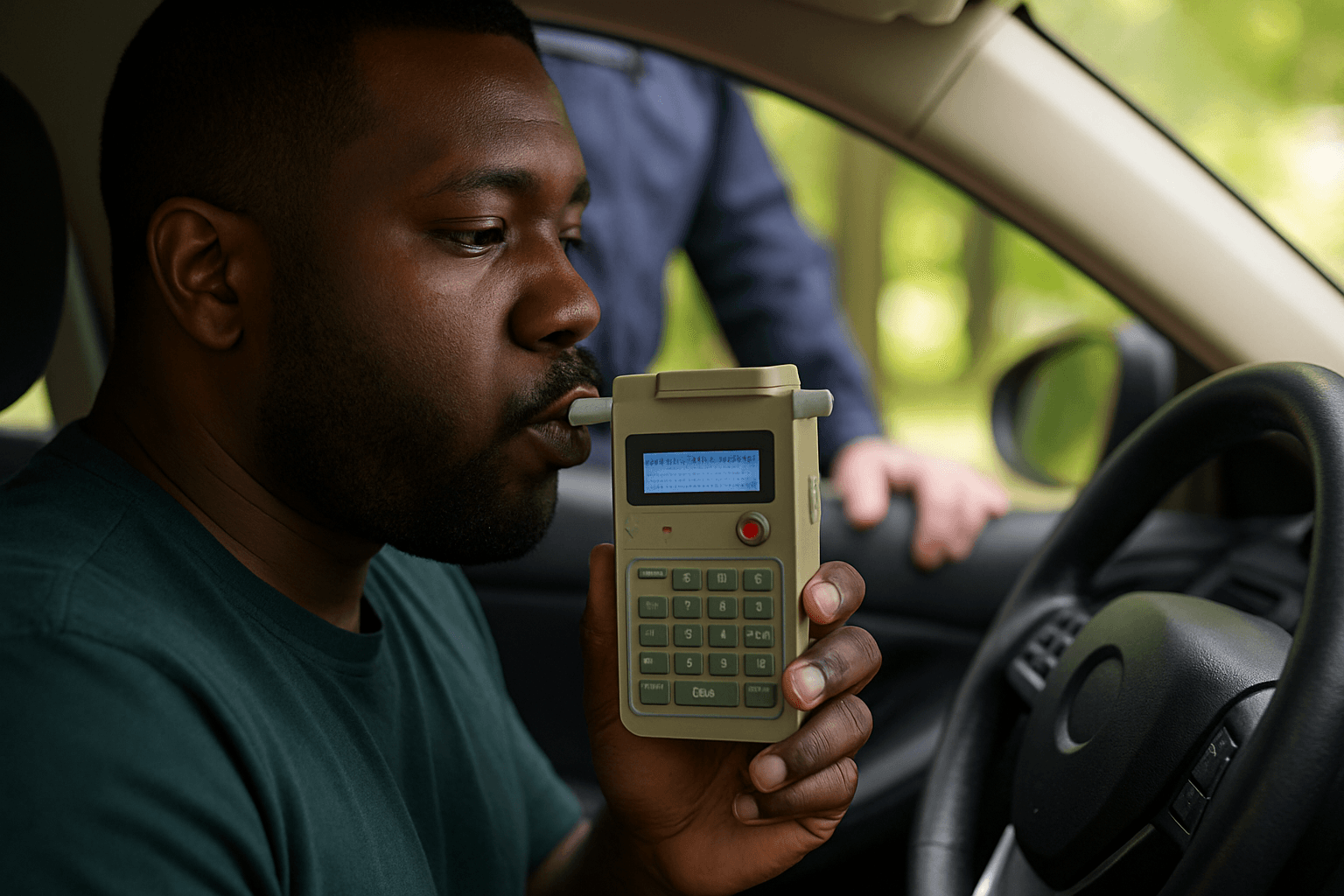
Ohio courts can require SCRAM or continuous alcohol monitoring alongside your occupational driving privileges. Here's how to comply with court-ordered monitoring, employer documentation, SR-22 filing, and ignition interlock simultaneously without losing your license or your job.
What Happens When Ohio Courts Order Alcohol Monitoring Alongside Your Occupational License
Ohio courts can impose continuous alcohol monitoring (CAM) as a condition of occupational driving privileges after an OVI conviction, particularly for second or subsequent offenses. The most common systems are SCRAM continuous alcohol monitoring bracelets and twice-daily breath testing via handheld devices. These monitoring requirements run concurrently with ignition interlock device (IID) requirements, not as replacements. You comply with both, or the court revokes your occupational license.
SCRAM ankle bracelets measure transdermal alcohol content every 30 minutes and transmit data to a monitoring agency. If the system detects alcohol, tampering, or missed uploads, the monitoring company reports the violation to the court within 24 hours. Handheld breath testing devices require tests at court-ordered times—typically morning and evening—with photo verification and GPS stamping. Missing a single test counts as a violation. The court typically orders monitoring for 90 days to 12 months depending on your offense level and prior history.
Your occupational license restricts you to employment travel, medical appointments, court-ordered programs, and religious services. The license runs for up to 5 years depending on your suspension length. Violating alcohol monitoring—detected alcohol, missed tests, or device tampering—triggers automatic license revocation and extends your underlying suspension. Most counties add 90 to 180 days to your suspension timeline for a first monitoring violation.
How SCRAM and IID Requirements Overlap in Ohio Occupational License Cases
Ohio requires ignition interlock for all OVI convictions as of April 2017. First-offense high-BAC (.17 or higher) and all second or subsequent offenses trigger mandatory IID periods ranging from 180 days to 5 years. If you hold an occupational license, you must install IID on any vehicle you operate, including employer-owned vehicles if you drive them during approved hours. The IID monitors every engine start and requires rolling retests every 5 to 15 minutes.
SCRAM monitoring and IID serve different compliance purposes. IID prevents vehicle operation if alcohol is detected at ignition; SCRAM detects alcohol consumption at any time, even when you're not driving. Courts order SCRAM when they want 24/7 sobriety verification, not just pre-drive testing. The systems do not communicate with each other. An IID violation—failed start, missed retest, or tampering—goes to the BMV and the monitoring authority. A SCRAM violation goes to the court. Both trigger occupational license revocation, but through different enforcement paths.
Monitoring costs stack. IID installation runs $70 to $150; monthly lease and monitoring fees run $70 to $100. SCRAM installation runs $50 to $100; daily monitoring runs $10 to $15, totaling $300 to $450 per month. Handheld breath devices cost $2 to $5 per test, or $120 to $300 per month for twice-daily testing. Courts do not waive monitoring fees for financial hardship in most Ohio counties. Budget for $400 to $550 per month in combined monitoring costs during the overlap period.
Compare car insurance rates in your state
Get quotes from licensed carriers — no obligation, no spam, results in minutes.
Get Your Free Quote✓ No Obligation Required✓ Licensed Carriers Only✓ Available Nationwide✓ Free to Compare
SR-22 Filing Requirements While on Occupational License and Alcohol Monitoring
Ohio requires SR-22 filing for the entire period of your occupational driving privileges. SR-22 is a certificate of financial responsibility your insurer files with the Ohio BMV proving you carry at least state minimum liability coverage: $25,000 per person, $50,000 per accident for bodily injury, and $25,000 for property damage. The SR-22 filing period begins the day your occupational license is issued and continues through the full suspension term plus any extensions triggered by monitoring violations.
SR-22 filing adds $15 to $25 to your policy as a one-time filing fee. The larger cost driver is the non-standard insurance premium. Occupational license holders with OVI convictions typically pay $140 to $280 per month for minimum liability coverage with SR-22 endorsement. Carriers writing occupational drivers in Ohio include Bristol West, Dairyland, GAINSCO, The General, Progressive, and Acceptance. Not all carriers will insure drivers with active SCRAM or IID requirements—some classify continuous monitoring as too high a compliance risk.
If your SR-22 lapses for any reason—missed payment, policy cancellation, coverage reduction below minimums—the BMV receives electronic notification within 24 hours and immediately suspends your occupational license. There is no grace period. Reinstatement after SR-22 lapse requires filing a new SR-22, paying a $40 reinstatement fee, and in some cases reapplying for occupational privileges. Maintain continuous coverage and confirm your insurer has filed SR-22 before driving on occupational privileges.
Application Process for Occupational License With Monitoring Conditions
Ohio occupational license applications are filed with the court that imposed your OVI suspension, not the BMV. You apply through a petition for limited driving privileges, typically filed 15 to 30 days after your suspension begins. The court holds a hearing where you present employer documentation, proof of insurance with SR-22, and a proposed driving schedule listing approved routes, approved hours, and approved purposes. The prosecutor can object. The judge grants or denies the petition based on your offense history, employment need, and prior compliance record.
If the court orders SCRAM or other continuous alcohol monitoring as a condition of occupational privileges, you must enroll with an approved monitoring provider before the license becomes active. The court provides a list of certified vendors. You schedule installation, pay the setup fee, and receive a compliance calendar showing required test times or device check-ins. The monitoring agency reports weekly or biweekly to the court. Your occupational license does not activate until the court confirms monitoring enrollment.
Employer documentation must include a letter on company letterhead stating your job title, work address, required work hours, and confirmation that driving is essential to your employment. If you drive an employer-owned vehicle, the letter must state the company consents to IID installation. Courts deny occupational petitions if the employer refuses IID or if your job allows remote work or public transit alternatives. Bring the employer letter, proof of SR-22 insurance, IID installation receipt, and SCRAM enrollment confirmation to your hearing. Missing any document typically results in continuance or denial.
Violation Consequences and Compliance Monitoring Timelines
Ohio courts revoke occupational licenses immediately upon first alcohol monitoring violation. Detected alcohol, missed breath tests, device removal, or signal interference all qualify as violations. The monitoring company uploads violation data in real time. The court issues a revocation order within 48 hours, and the BMV suspends the occupational license electronically. You receive notice by mail, but the suspension is effective the day the court issues the order, not the day you receive the notice.
Revocation adds time to your underlying suspension. First monitoring violations typically add 90 to 180 days. Second violations during the same suspension period can add 1 to 3 years. Some judges terminate occupational privileges entirely after a second violation, requiring you to serve the full remaining suspension with no driving relief. IID violations follow a separate enforcement path—three IID violations in 12 months trigger a 1-year IID extension and possible occupational license revocation depending on county.
Compliance timelines do not always align. Your court-ordered SCRAM period may end after 6 months, but your IID requirement may run 2 years, and your SR-22 filing may run 3 years. Track each deadline separately. Confirm SCRAM removal authorization in writing from the court before scheduling device removal. Confirm IID removal eligibility with the BMV Interlock Unit before uninstalling the device. Confirm SR-22 filing duration with your insurer and the BMV before canceling coverage. Ending any compliance requirement early without written authorization triggers suspension and restarts your filing or monitoring clock.
How to Budget for Combined Monitoring, IID, SR-22, and Occupational License Costs
Total first-year cost for occupational license compliance with SCRAM, IID, and SR-22 in Ohio typically ranges from $8,000 to $14,000. This includes court filing fees ($150 to $300), attorney fees if you hire counsel ($800 to $2,500), SR-22 insurance premiums ($1,680 to $3,360 annually), IID installation and monitoring ($840 to $1,200 annually), SCRAM or breath testing monitoring ($3,600 to $5,400 annually if ordered for 12 months), BMV reinstatement fees ($475 for OVI suspension), and occupational license issuance fees ($40).
Monitoring costs dominate the budget. If the court orders SCRAM for 12 months, expect $300 to $450 per month in monitoring fees alone. IID adds another $70 to $100 per month. SR-22 insurance adds $140 to $280 per month. These three costs run concurrently—budget $510 to $830 per month during the overlap period. If monitoring ends after 6 months but IID and SR-22 continue, monthly costs drop to $210 to $380.
Some Ohio counties allow payment plans for court-ordered monitoring, but the monitoring company—not the court—sets the terms. Missing a payment suspends monitoring enrollment, which the court treats as a compliance violation. Most monitoring vendors require automatic bank draft or credit card authorization. If your account declines, you have 24 to 48 hours to cure the payment before the company reports noncompliance to the court. Plan for uninterrupted payment ability for the full monitoring term.